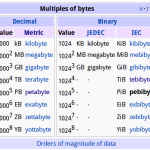
I was very excited to create my first > petabyte (pebibyte actually) single filesystem this afternoon! And sure enough, df -h reported the size in PiB. I remember filing a bug on df not supporting terabytes (tebibytes) over a decade ago. Thus, I was slightly surprised to discover that it knows about PiBs.
$ df -h /dev/mss1 /dev/dl1
Filesystem      Size  Used Avail Use% Mounted on
/dev/mss1       1.1P  663T  386T  64% /net/mss1
/dev/dl1        350T   18M  350T   1% /net/dl1
$ rpm -q coreutils
coreutils-8.4-31.el6_5.1.x86_64
This made me curious as to how ridiculously large of units df, dd, etc. support. It turns out that coreutils is using a function from gnulib to do the “humanizing”.
From gnulib/lib/human.h:
char *human_readable (uintmax_t, char *, int, uintmax_t, uintmax_t);
From gnulib/lib/human.c:
static const char power_letter[] =
{
  0,    /* not used */
  'K',  /* kibi ('k' for kilo is a special case) */
  'M',  /* mega or mebi */
  'G',  /* giga or gibi */
  'T',  /* tera or tebi */
  'P',  /* peta or pebi */
  'E',  /* exa or exbi */
  'Z',  /* zetta or 2**70 */
  'Y'   /* yotta or 2**80 */
};
Holy smokes! It supports the entire range of defined SI prefixes. df is ready to support “yotta-scale” filesystems; that’s a billion PiBs. I think that will hold me over for awhile. 😉 It makes me wonder if we’ll see new SI prefixes defined in my lifetime driven by storage capacities…